10th year anniversary
23rd May, 2026 | News & updates
This year in autumn, it will be the 10th year anniversary for this website and the idea of the gallery itself. It was on the October 13th 2016 when I took first photo with the intention to create such gallery. The first bird photographed in a standardized fashion was a male Yellowhammer (Emberiza citrinella; CZEP16-001). And while the exact standardized positions I photograph the birds in the field changed to some extent over the course of time, it is already evident that standardized pictures were my goal from the very beginning.
It is actually not any coincidence that Yellowhammer was the first species photographed. Back then I was finishing my masters’ thesis about Yellowhammers and their coloration, sexual selection etc. and I spent a great deal of time in the field with them. As a young bird ringer eager to learn, I was especially puzzled about ageing Yellowhammers and the lack of any good photographic material to learn how exactly the juvenile primary coverts and pointy rectrices looked like. And then, one day, I have found that there are things like Ottenby’s Ringer’s Digiguide ⧉ and the PDF files made by Javier Blasco Zumeta and Gerd-Michael Heinze ⧉ known as Identification Atlas of Aragon's Birds by that time. And these two sources basically changed my life forever. I especially admired the consistency, technical quality and general usefulness of both sources.
Yet, back then, around the years 2014-2015, the chapters dealing with Yellowhammer, in both sources, were rather incomplete. And that basically is the origin of my idea to collect photos of Yellowhammers in the field for such purposes. I had some experience with taking standardized pictures of birds in the field for the purposes of colour analysis using an “apparatus” of my own design, but this was another challenge. I knew that the photos in Ottenby are created using a small studio with studio quality flashes, cameras and with the help of more people, but I liked the lighting consistency and the grey background. On the other hand, photos from Javier were taken in the field which gave me some hope that my task might be achievable in the field, too. So, I decided to use flash or some other source of artificial lighting to standardize colours, grey background so that all the features nicely pop from the picture, a tripod and a remote shutter release. And it was around that time that I found photos of, now my friend, Yosef Kiat who was able to take pictures⧉ of same quality and lighting consistency as were being made in the studio at the Ottenby’s ringing station, but he was still able to take them in the field. So, in a way, independently, I was able to come up with a similar setup, albeit way less fancy (I will post a separate and more detailed article about the way I take the pictures in the field in a separate post). Because of the lack of money from my side, I know I never could have compete with the quality of photos by those three outstanding sources so my goal was a bit different from the very beginning. Instead of focusing on a field guide like e.g. Ottenby or Birds of Aragon, my plan was to photograph all the birds in standardized positions to capture the immense variability I was able to observe in Yellowhammers (and in other species). I did not want to just copy others; I wanted to expand their ideas and work in a different direction. And so, the journey began.
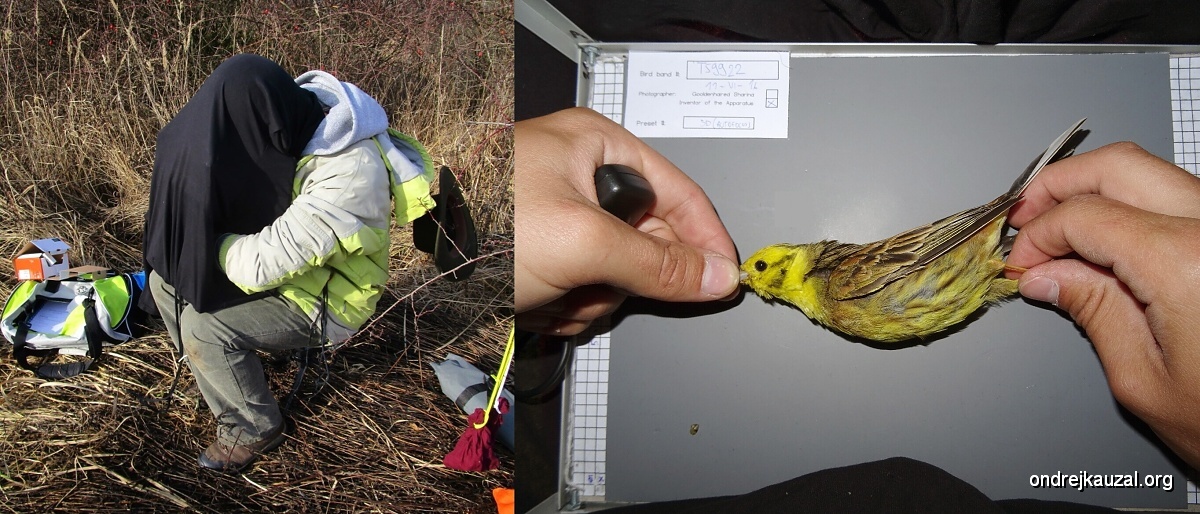
My original apparatus for taking standardised pictures of Yellowhammers in the field for the purpose of the colour analysis (sample picutre on the right). It was developped as a “dark chamber” which can be operated by a single person. It was especially funny to use alone. Oblivious to the surroundings sometimes when you exit the apparatus there was someone looking at you with horror and/or curiosity. Another source of fun was when the bird actually escaped your grip inside the apparatus itself :)
I was dedicated to the task and shortly after I took my first photos, I created the website where I planned to post them for everyone to see and use them. My intention was to be “open access” from the very beginning so that anyone can access the photos and (with proper credit) use them in their own projects. Even though I put a watermark to the photos uploaded, I am and always was, willing to share the unedited originals with anyone who has some interesting project and would find the photos useful. But the website was quite empty for quite a long time as it took almost year and a half before the first batch of photos was uploaded. Since then, I quite regularly update the gallery. First, manually, but since this year, finally, quite automatically using an internal database so that the website shows you the relevant pictures automatically. It also means, that after many years of promises, the filtering option is finally available. And it was desperately needed as some species became quite difficult to navigate through.
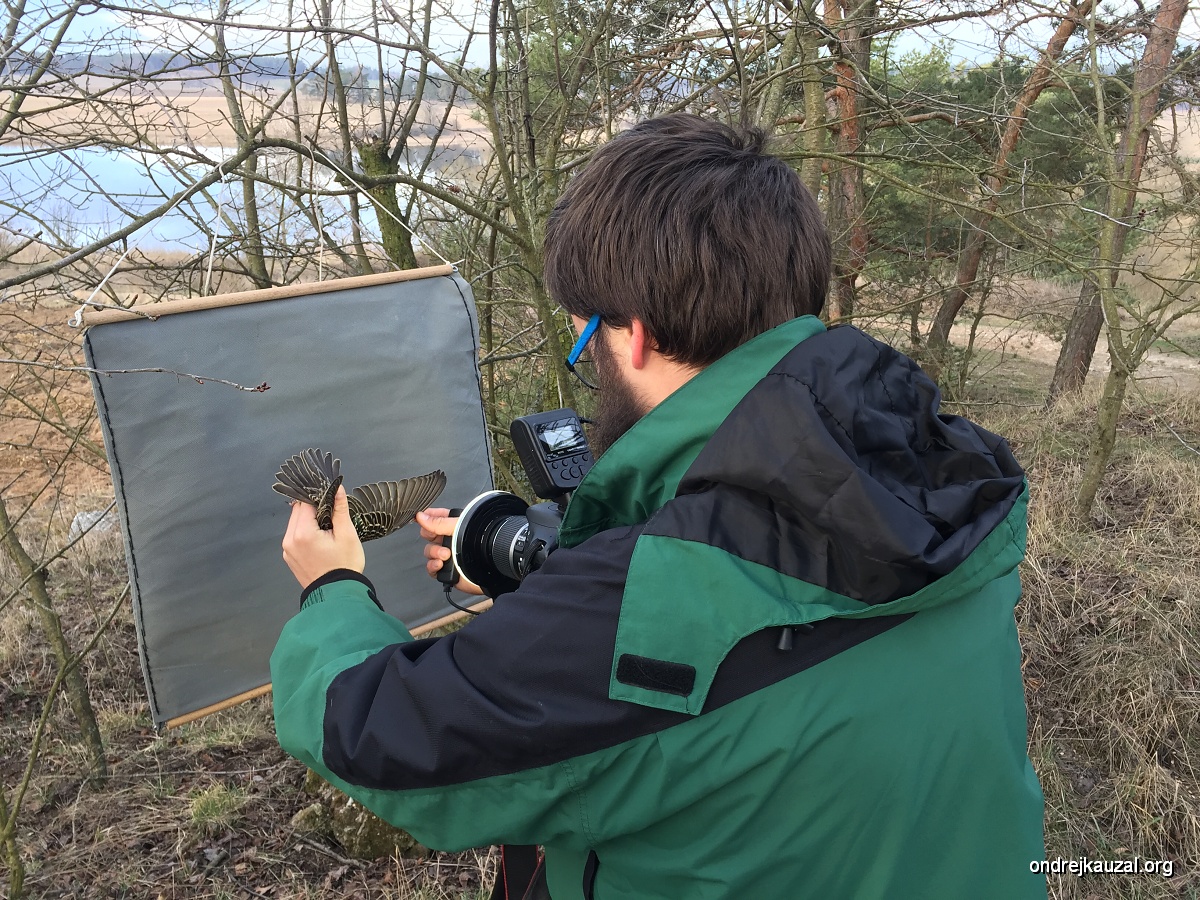
The author taking a wing picuture of the starling, showing one of the earlier designs of the setup used in the field: grey background hanging somewhere, camera mounted on a tripod controlled by remote shutter release so that both hands are able to hold and position the bird. You can see the LED ring light around the lens used to illuminate the scene.
Thanks to your feedback, which I am immensely grateful for, I know that the gallery has found its regular users who find it useful. Also, some of you regularly write me with some tips and corrections, which are all much appreciated! I am also very happy, that some of the photos made their way to the wonderful field guide made by Javier or to a Slovakian University textbook. I hope, you will find the gallery useful also in the future as I still plan to expand it, curate it and make it better for everyone who chooses to visit it.
Thank you!